Hydrilla And Milfoil Bass: How To Punch Through Thick Mat
Punching through thick hydrilla and milfoil mats requires a heavy rod, braided line, and a dense bait such as a soft plastic or swimbait rigged to penetrate cover directly. This technique allows anglers to reach bass holding in shaded ambush points beneath the vegetation where they feed on abundant baitfish and insects. Successful punching demands precise casts and a strong hookset to extract fish from dense aquatic vegetation, a key tactic for landing big bass.
When bass hide in thick vegetation, finding them can be tough. You need the right gear and techniques to get your lure to where the fish are. This guide will show you Hydrilla and Milfoil Bass: How to Punch Through Thick Mat so you can catch more fish.
Learning these methods means you won’t miss out on those big bass waiting in the weeds. We’ll cover the best baits, equipment, and how to make those crucial casts.
Key Takeaways
- Understand why bass love thick hydrilla and milfoil mats.
- Learn the essential gear needed for punching techniques.
- Master the best bait choices for punching through vegetation.
- Discover effective casting and retrieval strategies.
- Troubleshoot common problems when fishing thick mats.
- Improve your chances of landing big bass from dense cover.
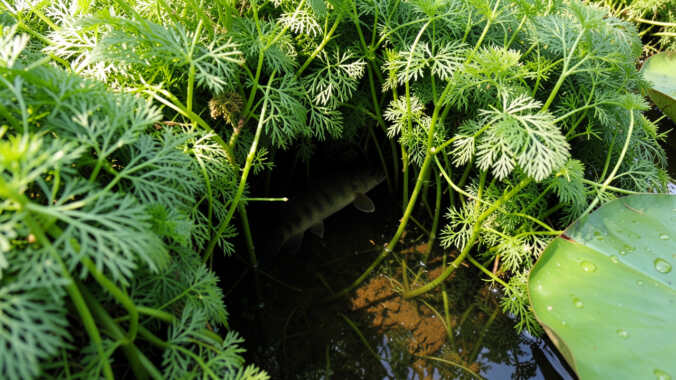
Why Bass Love Thick Aquatic Vegetation
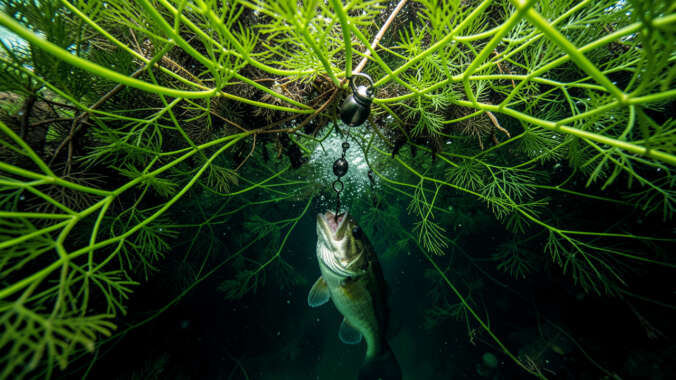
Bass are ambush predators. They love places where they can hide and wait for food to swim by. Thick mats of hydrilla and milfoil are perfect for this.
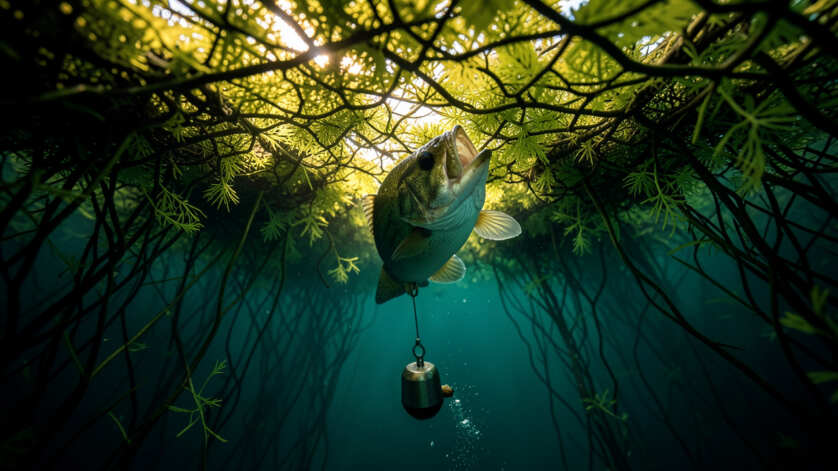
Look for dense hydrilla and milfoil mats as they offer bass shade, oxygen, and a safe ambush point near abundant baitfish.
These underwater jungles offer shade, oxygen, and a safe place to rest. Small baitfish and insects also gather in these areas, making them a prime feeding ground for bass. Knowing why they are there helps you fish more effectively.
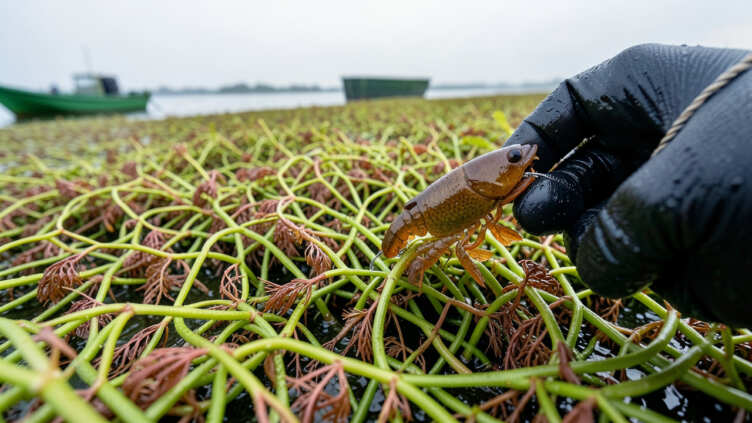
Hydrilla and Milfoil Bass: How to Punch Through Thick Mat fishing is all about getting your lure past the surface layer of weeds and down to where the fish are holding. These mats can be incredibly dense, often looking like solid ground from above. Without the right approach, your lure will just get snagged or sit on top, completely missing the fish below.
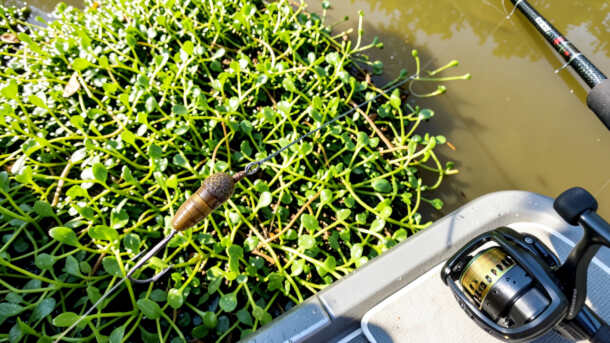
Essential Gear for Punching Mats
Successfully fishing through thick hydrilla and milfoil requires specialized equipment. Your standard gear might not cut it. You need rods that can handle the strain and lines that won’t break.
This setup is designed to punch through vegetation and pull a big fish out of heavy cover.
The Right Rod
For punching, you need a heavy-action rod. This gives you the backbone to pull bass out of thick weeds. Look for rods that are 7 feet 6 inches to 8 feet long.
The extra length helps with casting distance and leverage when fighting a fish. A stiff rod is crucial for driving the hook through the fish’s mouth and keeping it pinned.
Punching thick mats requires a heavy-action rod between 7 feet 6 inches and 8 feet long paired with 50- to 80-pound braided line to cut through vegetation and pull bass from heavy cover.
Strong Line is Key
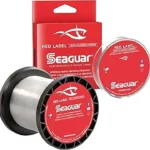
Braided line is the go-to for punching. It has no stretch, which means you have direct contact with your lure and can set the hook instantly. It also cuts through vegetation better than monofilament or fluorocarbon.
Use a heavy test, typically 50-pound to 80-pound braid. This ensures you can handle the brute force of a large bass in thick cover.
Reel Considerations
You’ll want a reel with a strong, smooth drag system. A high gear ratio reel can help you quickly reel in slack line and bring a fighting fish out of the weeds. Make sure the reel is durable and can withstand the abuse of fishing in heavy cover.
A baitcasting reel is generally preferred for its power and control.
Choosing the Best Baits for Punching
The type of bait you use is critical for Hydrilla and Milfoil Bass: How to Punch Through Thick Mat. The goal is to have a compact bait that can easily penetrate the weed mat and entice a bite. Many successful punching baits are designed to be weedless and sink quickly.
Soft Plastics
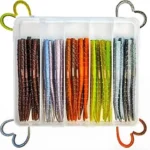
Soft plastic baits are very popular for punching. Many are designed to be rigged weedless. Common choices include creature baits, craws, and compact jigs.
These baits often have a natural action that mimics prey. They sink well and can be rigged in various ways to improve their weedless properties.
Punch Skirts and Flipping Jigs
A staple for punching is the flipping jig or punch skirt. These are designed specifically for heavy cover. They have a stout hook and a weed guard to prevent snags.
Successful punch baits are compact, weedless, and fast-sinking to penetrate the mat and trigger strikes.
You can add a trailer to give the bait more action and bulk. The compact profile allows them to slip through the mat with ease.
Creature Baits and Craws
Other excellent soft plastic options include creature baits and crawfish imitations. These often have multiple appendages that create subtle water movement, attracting bass. Rigging them Texas-style with a bullet weight helps them fall straight and fast through the vegetation.
Ensure your hook is sharp and weedless.
Swimbaits and Other Options
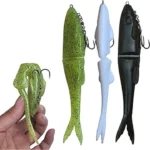
While less common, some anglers have success with small, compact swimbaits. These can be rigged weedless on an EWG hook. The subtle tail kick can trigger strikes.
The key is keeping the bait compact and ensuring it can be rigged to be as snag-free as possible for effective Hydrilla and Milfoil Bass: How to Punch Through Thick Mat fishing.
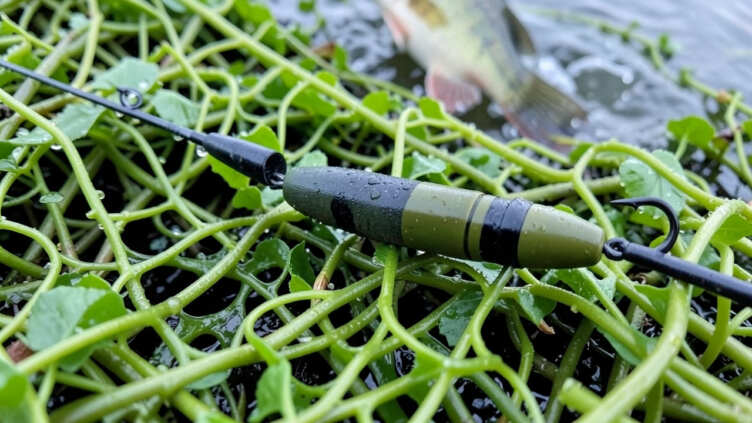
Rigging Your Punch Bait
Proper rigging is essential for punching. A poorly rigged bait will snag easily and won’t get down to the fish. The most common method is the Texas rig, which keeps the hook point buried in the bait until a fish strikes.
First, select a stout, extra-wide gap (EWG) hook. The size will depend on your bait, but generally, a 4/0 or 5/0 hook is suitable. Thread your chosen soft plastic bait onto the hook.
Use tungsten weights instead of lead; they are denser so a smaller size provides the same punching power, helping your bait penetrate thick mats more effectively.
Ensure the hook point is buried within the plastic but can easily penetrate when a fish bites. You can use a small amount of super glue to keep the bait from sliding up the hook, especially when punching repeatedly.
Next, add a tungsten bullet weight to the line in front of the bait. Tungsten weights are denser than lead, allowing you to use a smaller weight for the same amount of power, which helps it punch through the mat better. The weight size typically ranges from 1/2 ounce to 1 1/2 ounces, depending on the thickness of the vegetation and the depth you are fishing.
You can peg the weight using a small piece of plastic or a bobber stop to keep it from moving.
Casting and Presentation Techniques
The act of “punching” involves a specific casting motion. It’s not a long, sweeping cast. It’s more of a precise, forceful pitch or flip aimed at small openings in the weed mat.
The Punch Cast
To make a punch cast, hold the bait in your hand near the rod tip. With the rod tip down, swing the bait and weight forward in a controlled, forceful motion. Aim for a small hole or thinner section of the mat.
The weight of the bait will carry it through the vegetation. This technique requires practice to master.
Avoid long sweeping casts when punching; instead, use a precise, forceful pitch or flip aimed at small openings in the weed mat to ensure your bait gets through.
Targeting the Right Spots
Look for areas where the mat is slightly thinner or has natural gaps. Edges of mats, points, or areas where grass might be less dense are good starting points. You’re not trying to punch through the thickest part every time, but rather find the weakest points.
This is key for successful Hydrilla and Milfoil Bass: How to Punch Through Thick Mat.
Working the Bait
Once your bait hits the water, let it sink on a semi-slack line. Feel for the bait to hit the bottom or a weed bed below the mat. If you don’t get a bite on the initial fall, give the bait a few subtle twitches or hops.
You can also drag it a short distance along the bottom. If there’s no action, reel it up and try another spot.
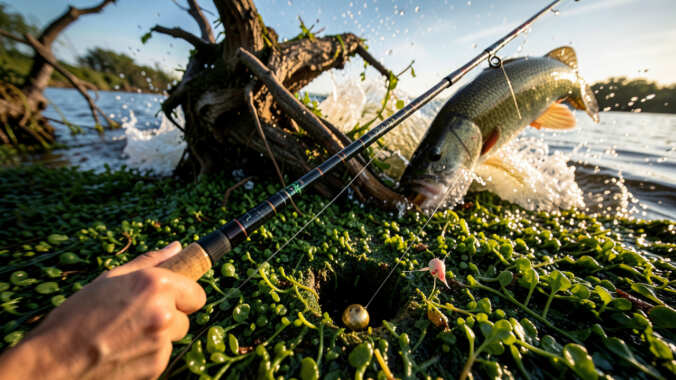
Setting the Hook and Fighting the Fish
Hooksets and fights in heavy cover are intense. You need to be decisive and strong.
The Aggressive Hookset
When you feel a bite, it’s usually a subtle tap or a dead weight. You need to react instantly. Set the hook with a strong, upward sweep of the rod.
Because you’re using braided line and a heavy rod, you can drive the hook home effectively. The power of the rod is crucial for getting through the vegetation and into the fish.
When a bass bites in thick cover, set the hook with a strong upward sweep and then keep your rod tip up while reeling down hard to maintain steady pressure and prevent the fish from diving back into the mat.
The Bulldogging Technique
Once hooked, the bass will likely try to run back into the thick vegetation. Your job is to turn the fish away from cover immediately. Keep your rod tip up and reel down hard.
Apply steady pressure. Don’t give the fish any slack. If the fish gets into the weeds, try to pull it out sideways rather than straight up.
This is where the heavy-duty gear for Hydrilla and Milfoil Bass: How to Punch Through Thick Mat truly shines.
Landing the Fish
Once you’ve fought the fish to the boat, landing it can still be tricky. You might need a strong net or a dehooking tool to safely get the fish out of the weeds and into your boat. Be prepared for the fish to be tangled in grass.
Troubleshooting Common Punching Problems
Even with the right gear and techniques, you might run into issues. Here are some common problems and how to solve them.
Adjust your weight and bait action based on mat thickness and bass activity to solve common snagging or bite issues.
- Constantly Snagging: Ensure your bait is rigged weedless. Check your hook point and make sure it’s buried. Try a different bait or rigging style. Sometimes, a lighter weight can help if the mat is not too thick.
- Not Getting Bites: Bass might be finicky. Try a more subtle bait or a slower retrieve. Adjust your weight to get your bait to the strike zone faster or slower. The color of your bait can also be a factor.
- Fish Coming Off: This often happens if the hook isn’t set properly or if you give the fish slack. Ensure your hookset is aggressive. Keep constant pressure on the fish throughout the fight.
- Lure Not Punching Through: Your weight might be too light, or the vegetation is exceptionally dense. Try a heavier tungsten weight. Ensure your rod has enough power to drive the bait through.
When to Fish Thick Mats
Certain conditions make punching mats more effective.
Fish thick mats during warm water temperatures, low light conditions at dawn and dusk, overcast days, and post-spawn periods for the best results.
- Warm Water Temperatures: Bass are generally more active in warmer water, often seeking the cooler shade of thick mats during hot summer days.
- Low Light Conditions: Dawn and dusk are prime times. Bass are more likely to move into the edges of mats to feed.
- Overcast Days: Similar to low light, overcast conditions can encourage bass to venture out from deep cover.
- Post-Spawn: After spawning, bass will retreat to these areas to recover and feed.
Understanding these conditions can significantly improve your success rate when targeting Hydrilla and Milfoil Bass: How to Punch Through Thick Mat.
Advanced Punching Tips
Once you’ve got the basics down, here are some ways to refine your technique.
Varying Your Weights
Don’t get stuck using only one weight. If the mat is very thick, you might need 1 ounce or even 1 1/2 ounces to punch through effectively. If it’s a thinner mat or you’re fishing edges, a 3/8 ounce or 1/2 ounce weight might be better.
Tungsten is key for its compact size.
Experimenting with Baits
While craws and creature baits are standard, don’t be afraid to try other things. Small, compact stick baits or even a weedless fluke can sometimes produce. The key is always about the presentation: getting it through the weeds and into the strike zone.
Reading the Water
Pay attention to the types of vegetation. Is it solid hydrilla, or is it mixed with milfoil and some open water? Look for any signs of baitfish activity or breaks in the mat.
These subtle cues can guide you to where the bass are holding.
The Importance of Stealth
When approaching a mat, try to be as quiet as possible. Avoid making loud noises that might spook the fish. A well-placed, quiet cast is often more effective than a loud, splashy one.
Frequently Asked Questions
Question: What is the best time of year for Hydrilla and Milfoil Bass: How to Punch Through Thick Mat fishing?
Answer: This technique is most effective during the warmer months, from late spring through early fall, when aquatic vegetation is thickest and bass actively use it for cover and feeding.
Question: Can I use fluorocarbon line for punching?
Answer: While some anglers use heavy fluorocarbon, braided line is generally preferred for punching because it has no stretch and cuts through vegetation better. If you use fluorocarbon, ensure it’s a very heavy test (60lb+).
Question: How do I know if a fish is biting when punching?
Answer: Bites often feel like a subtle tap, a slight weight change, or the bait stopping dead. Sometimes, it’s just a dead weight. React quickly with a strong hookset.
Question: What weight should I use when punching?
Answer: Weights typically range from 1/2 ounce to 1 1/2 ounces. Use heavier weights for thicker mats and lighter weights for thinner vegetation or when you need a slower fall rate.
Question: Is it possible to catch a bass without punching through the mat?
Answer: Yes, bass can be caught around mats by fishing the edges or in pockets, but punching is the most effective way to target bass holding deep within the thickest parts of the vegetation.
Question: How do I prevent my bait from getting fouled with weeds?
Answer: Proper rigging with weedless hooks and weights is crucial. Ensure the hook point is buried in the bait. Using tungsten weights also helps cut through weeds better.
Final Thoughts
Mastering Hydrilla and Milfoil Bass: How to Punch Through Thick Mat fishing opens up a world of hidden bass. With the right rod, strong braid, and a weedless bait, you can consistently reach those fish. Practice your punching cast and aggressive hookset.
You’ll soon be pulling giants out of the thickest cover.