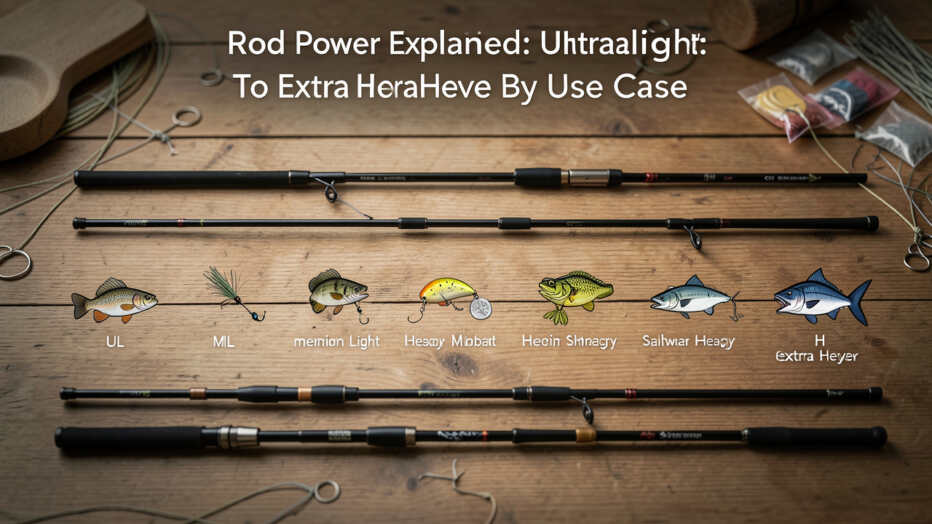
Rod Power Explained: Ultralight To Extra Heavy By Use Case
Rod power, from ultralight to extra heavy, indicates the bending resistance of a fishing rod, directly determining the appropriate fish species and lure weights for effective use. Ultralight rods excel with delicate presentations and small prey like panfish, while medium power rods serve as versatile all-around workhorses for moderate fish and lures. Medium-heavy and heavy rods handle aggressive techniques and larger fish such as bass, with extra-heavy rods built for giants like musky or heavy saltwater species. Understanding this power scale ensures proper rod selection for better casting, control, and success across diverse fishing scenarios.
Choosing the right fishing rod can make a huge difference in how much fun you have and how successful you are on the water. It’s not just about length; the power of the rod is super important. This refers to how much force it takes to bend the rod.
Understanding Rod Power Explained: Ultralight to Extra Heavy by Use Case helps you pick the perfect tool for the job, whether you’re chasing tiny trout or wrestling big bass. Getting this right means better casting, more control, and a more enjoyable fishing experience every time you go out.
Key Takeaways
- Rod power describes how much a fishing rod bends under pressure, crucial for matching the rod to fish and lure types.
- Ultralight rods are best for small fish and delicate presentations, offering maximum sensitivity.
- Medium and medium-heavy power rods offer versatility for a wide range of fish and techniques.
- Extra-heavy rods are designed for the largest fish and strongest lures, providing immense lifting power.
- Matching rod power to your fishing needs improves casting accuracy, lure action, and fish-fighting ability.
- Understanding rod power helps anglers avoid equipment failure and enhances their overall fishing enjoyment.
What Rod Power Really Means
When we talk about rod power, we’re talking about how stiff a fishing rod is. Think of it like a spring. A weak spring bends easily.
A strong spring needs a good push to bend. Fishing rods are similar. Rod power tells you how much pressure it takes to bend the tip of the rod down towards the handle.
This isn’t about how far the rod bends, but how much force is needed to bend it a certain amount. This is measured by the rod’s backbone. A rod with a strong backbone is powerful.
Rod power is essentially a measure of the rod's backbone stiffness, indicating the force required to bend it. This rating directly affects your ability to detect bites and control fish.
A rod with a softer backbone is less powerful.
The power rating is usually printed on the rod itself. You’ll see terms like Ultralight, Light, Medium, Medium-Heavy, Heavy, and Extra-Heavy. Each of these ratings tells you something important about what the rod is good for.
Understanding this helps you make better choices for your fishing trips.
Matching Rod Power to Your Target Fish and Lures
The main reason rod power matters is that it needs to match the size of the fish you’re trying to catch and the weight of the lures you’re using. Using the wrong power can lead to problems.
For example, if you use a super-powerful rod for tiny fish, you might not feel their bites very well. The rod is too stiff. The fish might also get hurt more by such a strong rod.
On the other hand, if you try to catch a giant fish with a very light rod, the rod could break. It just won’t have the strength to handle the fight.
Always match rod power to your lure weight: heavier lures require a stiffer rod for efficient casting. Using an ultralight rod with a heavy lure can lead to poor performance and potential damage.
Similarly, lures have weight. Lighter lures need a less powerful rod to cast them effectively. Heavier lures need a more powerful rod to launch them accurately and far.
This is a key part of Rod Power Explained: Ultralight to Extra Heavy by Use Case.
Here’s a quick look at how power relates to fish size and lure weight:
Ultralight Rods: For Delicate Bites and Small Prey
Ultralight rods are at the very bottom of the power scale. They are incredibly flexible and sensitive. You can feel the slightest nibble with these rods.
They are perfect for catching very small fish. Think of bluegill, crappie, or small trout. These fish often have a very light bite.
An ultralight rod lets you detect those subtle takes easily.
Ultralight rods let you feel the slightest nibble from small fish, making them ideal for delicate presentations with tiny lures.
You also use ultralight rods with very small and light lures. Things like tiny inline spinners, small jigs, or small imitation insects work well. These lures don’t weigh much.
A stiff rod would struggle to cast them far. The flexibility of an ultralight rod helps you cast these light lures with accuracy.
The downside is that ultralight rods are not for fighting big fish. If a large fish grabs your bait, an ultralight rod will bend a lot. It might even break.
They also don’t have much power to pull a fish out of heavy cover.
Light Power Rods: A Step Up in Versatility
Light power rods are just a bit stiffer than ultralight rods. They offer a good balance between sensitivity and strength. You can still feel subtle bites with a light rod.
These rods are great for trout fishing in streams and rivers. They also work well for panfish like perch and some smaller bass species. You can cast small crankbaits, spinners, and light jigs with them.
A light power rod offers a good balance between sensitivity and backbone, perfect for trout and panfish. It allows you to enjoy the fight while still having enough power to control the fish.
A light rod gives you more backbone than an ultralight. This means you have a bit more power to control a fish. You can still have a fun fight with a decent-sized fish on a light rod.
They are a popular choice for anglers who enjoy the fight as much as the catch.
Medium Power Rods: The All-Around Workhorse
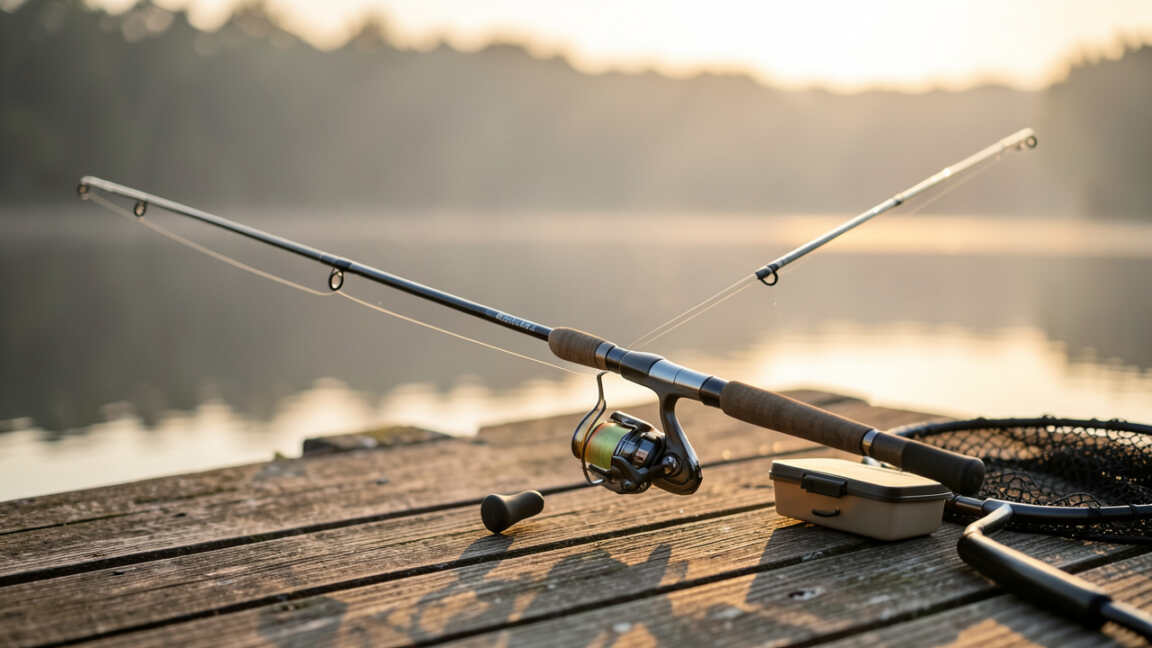
Medium power rods are arguably the most popular type of fishing rod. They are very versatile. This makes them suitable for many different types of fishing.
If you fish for bass, walleye, or even smaller catfish, a medium power rod is often a great choice. You can use them with a wide range of lures. This includes jigs, Texas-rigged plastics, crankbaits, and topwater lures.
While medium power rods are versatile, avoid using them for extremely heavy lures or very large fish as they may lack the backbone for proper hook sets and control.
A medium rod has enough stiffness to cast lures in the 1/4 ounce to 5/8 ounce range effectively. It also has the power to set hooks firmly and to handle fish up to a few pounds with confidence. Many anglers start with a medium power rod because it can do so many things well.
The sensitivity is good, though not as extreme as ultralight or light rods. You’ll still feel most bites clearly. This makes them a fantastic all-around option for many fishing situations.
Medium-Heavy Power Rods: For More Aggressive Techniques
When you need a bit more muscle, medium-heavy power rods come into play. These rods are stiffer and have more lifting power than medium rods.
They are excellent for bass fishing, especially when using heavier lures or fishing in thicker cover. Think about fishing with large jigs, heavy Texas-rigged worms, or frog lures for bass that hide in weeds. A medium-heavy rod can punch those lures through cover and has the power to pull a fish out.
Medium-heavy rods excel in thick cover because their extra stiffness allows you to punch lures through vegetation and set hooks firmly. They provide the extra muscle needed for large jigs and heavy Texas rigs.
These rods are also good for larger walleye or smaller northern pike. They offer better control when dealing with stronger, more aggressive fish. You can cast lures in the 3/8 ounce to 1 ounce range quite well with a medium-heavy rod.
The trade-off for this power is a slight decrease in sensitivity compared to lighter rods. However, for the types of fishing they are designed for, this is usually not a major issue. You gain significant control and hook-setting ability.
Heavy Power Rods: Tackling Bigger Fish and Heavier Lures
Heavy power rods are built for serious fishing. They are stiff and strong. These rods are designed to handle larger fish and heavier fishing lures.
If you’re targeting big bass in thick vegetation, musky, or pike, a heavy rod is often necessary. They provide the brute force needed to control these powerful fish. This is crucial when they try to run into snags or dive deep.
Heavy power rods give you the brute force to control big fish and cast heavy lures, essential for musky, pike, and thick vegetation bass.
Heavy rods are also ideal for casting large swimbaits or heavy jigging lures. The weight of these lures can be up to 1.5 ounces. The rod has the backbone to load up and cast them a good distance.
When fishing in dense weeds or submerged structures, a heavy power rod is your best friend. It allows you to steer a big fish away from danger and bring it to the boat without putting too much strain on the equipment.
Extra-Heavy Power Rods: For Giants of the Water
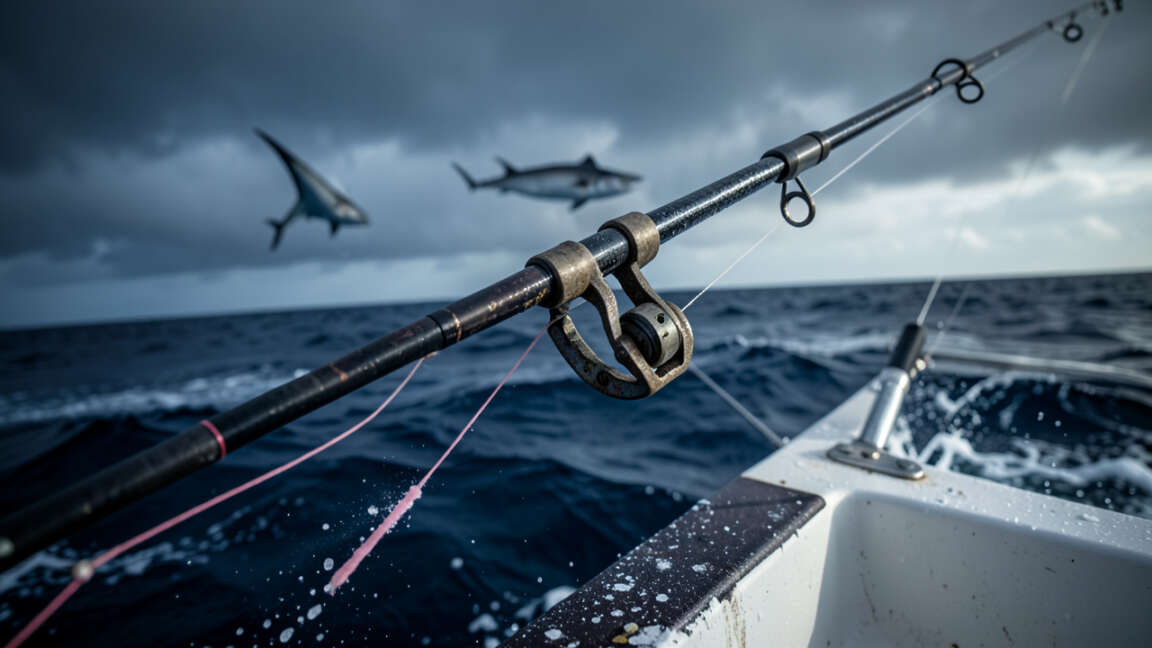
At the top of the power spectrum are extra-heavy rods. These are the powerhouses of the fishing world. They are built for the biggest and strongest fish you can imagine.
Anglers targeting giant musky, massive pike, or large saltwater game fish like tuna or stripers often use extra-heavy rods. These fish can exert incredible pressure. An extra-heavy rod has the strength to withstand that pressure and subdue the fish.
Extra-heavy rods are not for everyday fishing; they are specialized tools for the largest game fish. Using one for smaller fish can reduce sensitivity and make the fight less enjoyable.
These rods are also used for specific techniques like trolling with large lures or using very heavy bait rigs. The lure weights can easily exceed 2 ounces or more. The rod’s construction is designed to handle the constant stress of these methods.
Using an extra-heavy rod for smaller fish would be overkill. It would make casting light lures difficult and take all the fun out of fighting a small fish. But for the giants, they are essential tools.
Action vs. Power: Understanding the Difference
It’s important to remember that rod power is different from rod action. Both are critical for choosing the right rod, but they describe different things.
Rod Power is about how much force it takes to bend the rod. It’s about the stiffness and lifting strength. We’ve covered this extensively: Ultralight to Extra Heavy.
Rod Action describes where the rod bends along its length. This affects how the rod casts, how it feels when fighting a fish, and how sensitive it is.
Here’s a quick breakdown of action:
- Fast Action: The rod bends mostly at the tip. This offers great sensitivity and quick hook sets.
- Moderate Action: The rod bends in the upper half. This provides a good balance for casting and fighting fish.
- Slow Action: The rod bends throughout its entire length. This is great for casting light lures and for absorbing the shock of a fish’s fight, preventing hooks from pulling out.
You can have a rod that is, for example, a Medium power with a Fast action. This means it’s moderately stiff overall but bends mostly at the tip. Or you could have a Medium power rod with a Moderate action, meaning it’s moderately stiff and bends in the upper half.
When looking at Rod Power Explained: Ultralight to Extra Heavy by Use Case, always consider both power and action. They work together to define a rod’s performance.
How Rod Power Affects Casting and Lure Presentation
The power of your rod plays a big role in how well you can cast and how your lures behave in the water.
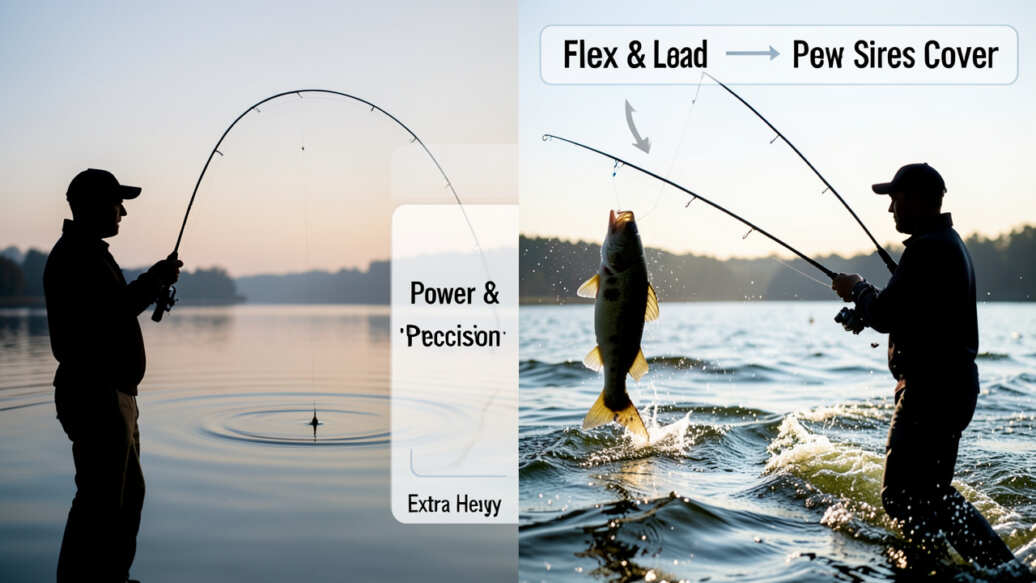
Casting: A rod’s power is directly related to its ability to load up when you cast. A lighter rod needs less weight to bend and store energy for the cast. This is why ultralight rods are best for light lures.
A heavier rod needs more weight to bend properly. Trying to cast a light lure with a heavy rod will result in poor distance and accuracy.
Conversely, a heavy rod is needed to cast heavy lures. The weight of the lure will bend a heavy rod enough to store the energy needed for a long, powerful cast. A light rod simply can’t handle that weight and will feel overloaded or even break.
Lure Presentation: The rod’s power also affects how your lure moves in the water. For example, a fast-action, medium-power rod might impart a jerky action to a crankbait. A slow-action, medium-power rod might give that same crankbait a smoother, more rolling action.
When using finesse techniques, like drop-shotting, an ultralight or light rod with a sensitive tip is essential. It allows you to present the bait naturally and detect the slightest bite. For techniques like frogging, where you need to pull bass out of thick lily pads, a medium-heavy or heavy rod with a fast action provides the power and control to make that happen.
Choosing the Right Rod Power for Different Fishing Scenarios
Let’s break down some common fishing scenarios and what rod power is typically best.
Freshwater Fishing
- Trout Fishing (Streams): Ultralight or Light power rods are usually ideal. They allow for delicate presentations of small lures and baits, and the fight of a trout is more enjoyable on these lighter rods.
- Panfish (Crappie, Bluegill): Ultralight to Light power is perfect. You want to feel those subtle bites and enjoy the fight of these smaller fish.
- Bass Fishing (General): A Medium power rod is a great starting point. For more specific bass techniques, consider Medium-Heavy for jigs and Texas rigs, or even Heavy for frogging and punching through thick cover.
- Walleye Fishing: Medium to Medium-Heavy power rods are popular. They offer good sensitivity for detecting bites and enough backbone for hooksets and fighting these fish.
- Pike and Musky Fishing: You’ll need Heavy to Extra-Heavy power rods. These fish are powerful and often hit large, heavy lures, requiring significant strength to cast and control them.
Saltwater Fishing
- Inshore Light Tackle (e.g., Speckled Trout, Redfish): Medium to Medium-Heavy power rods are common. They handle the weight of saltwater lures and the strength of coastal game fish.
- Offshore Trolling (e.g., Tuna, Mahi-Mahi): Heavy to Extra-Heavy power rods are essential. These rods are built to withstand the drag of large, fast-running fish and the stress of trolling heavy lures or downriggers.
- Surf Fishing: Depending on the target species and lure/bait weight, you might use Medium-Heavy to Extra-Heavy power rods. Longer rods are also common here for casting distance.
The principles of Rod Power Explained: Ultralight to Extra Heavy by Use Case apply across both freshwater and saltwater environments, though the specific power ratings might lean towards the heavier end for saltwater species.
When to Choose a Heavier Rod Power
You should lean towards a heavier rod power when:
- You are targeting large, strong fish that can pull hard.
- You are fishing in heavy cover, like thick weeds, submerged logs, or dense brush, where you need to pull fish out quickly.
- You are using heavy lures, such as large swimbaits, heavy jigs, or large casting plugs.
- You need to cast very heavy baits or use trolling setups.
- You want maximum leverage to set hooks at a distance or against strong currents.
When to Choose a Lighter Rod Power
Opt for a lighter rod power when:
- You are targeting small fish that have a light bite and are easily spooked.
- You are using very light lures and need to cast them accurately and with distance.
- You want to feel every subtle tap and vibration from the water, maximizing sensitivity.
- You enjoy the challenge and fight of landing smaller fish on lighter tackle.
- You are fishing in open water with no obstructions where a strong pull isn’t immediately needed.
Frequently Asked Questions
What is the most common rod power?
The most common rod power is Medium. It offers great versatility for a wide range of fish and techniques.
Can I use an ultralight rod for bass fishing?
While you can use an ultralight rod for very small bass or finesse techniques in open water, it’s generally not recommended for typical bass fishing, as it lacks the power to handle larger fish and heavier lures.
Does rod power affect hook setting?
Yes, rod power significantly affects hook setting. Heavier rods provide more power to drive the hook into a fish’s mouth, especially at a distance or when using lures with stiff actions.
What is the difference between rod power and rod action?
Rod power refers to how much force it takes to bend the rod, indicating its stiffness and lifting strength. Rod action describes where the rod bends along its length (tip, middle, or full), affecting its responsiveness and casting.
Is heavier rod power always better for big fish?
Yes, for big, strong fish, heavier rod power is almost always better. It provides the necessary strength to control the fish, prevent break-offs, and ensure you can land them safely.
How does rod power relate to lure weight?
Rod power dictates the range of lure weights that a rod can effectively cast and work. Lighter rods are for lighter lures, and heavier rods are for heavier lures.
Should I consider rod power when fishing for saltwater species?
Absolutely. Rod Power Explained: Ultralight to Extra Heavy by Use Case is crucial for saltwater fishing, as many saltwater species are larger and fight harder, requiring more powerful rods.
Final Thoughts
Choosing the right rod power means matching your gear to the fish you seek and the lures you use. Whether you need the delicate touch of an ultralight or the brute force of an extra-heavy, understanding these ratings ensures more successful and enjoyable fishing trips. Experimenting with different powers will help you find your favorites.

3 Comments